
There is a particular kind of report that recurs, almost word for word, across two thousand years of human record. A person - very often a young woman, sometimes a troublesome boy - begins to behave in ways that frighten the people around them. They convulse, they rage, they speak in voices that are not their own, they reject prayer and sacred things. The community decides the cause is not illness but invasion: a demon has taken up residence inside the body. And so someone steps forward who claims the power to drive it out.
The remarkable thing about the belief in demonic possession is not that it existed, but that it has never really gone away. It survived the rise of medicine, the Enlightenment, the laboratory, and the psychiatric ward. As one Berlin correspondent wrote in 1892, on reading the official report of a Bavarian priest who had spent two days exorcising a boy, one really has to stop and ask whether one is living at the close of the nineteenth century at all. He might have asked the same question in almost any century he chose.
This is the long, strange, and frequently tragic history of the conviction that devils can live inside us - and of the people who have always promised to get them out.
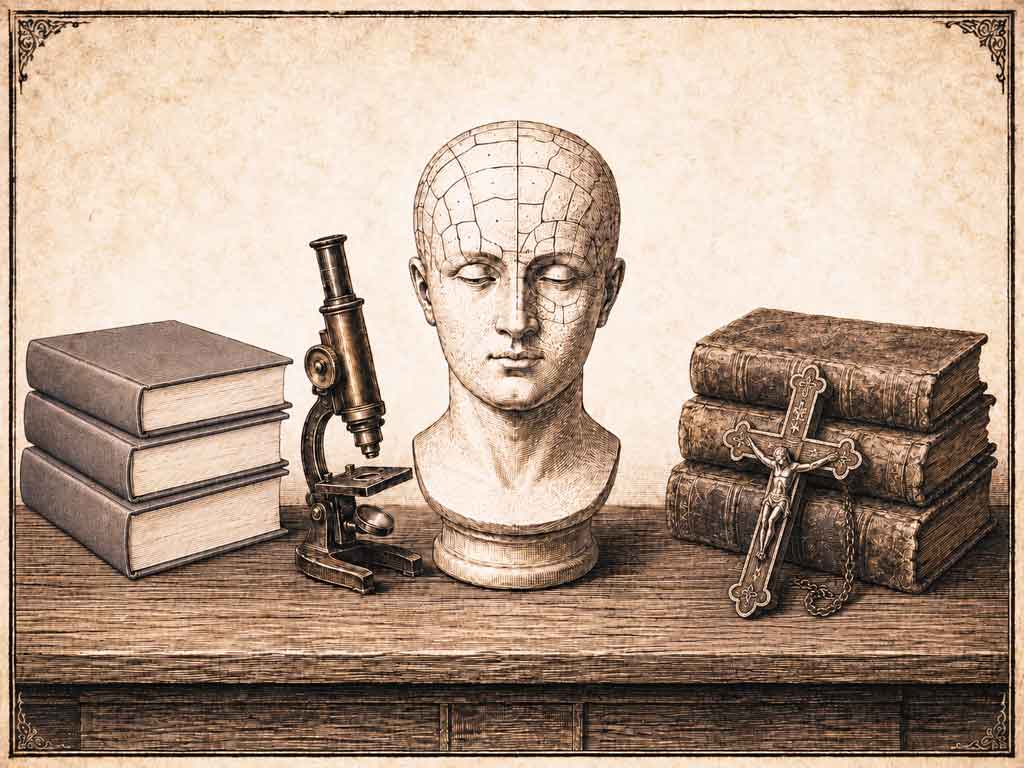
The Belief Older Than Christianity
It is tempting to imagine demonic possession as a specifically Christian idea, but the conviction is far older and far more widespread than any single faith. When the Victorian rationalist John M. Robertson surveyed the relationship between paganism and Christianity in 1892, he noted dryly that there was almost no form of European religious practice without a pagan counterpart, and that the practice of exorcism in particular was common to "heathens" and Christians alike. Casting out spirits was simply part of the spiritual furniture of the ancient world.
Trace the belief back to its roots and it leads, again and again, to the same source. A 1926 essay on exorcism by the writer J. W. Jack argued that the whole apparatus of evil spirits descended from early Semitic ideas, probably Babylonian, which passed into Hebrew thought during the Exile, then into the Greco-Roman world, and finally into Europe and America. The demonology of the New Testament, on this reading, is essentially the Babylonian system stripped of its cruder and more exaggerated features - unclean spirits that hover about a human being and must be driven out by some superior power.
The anthropological evidence supports the sheer universality of the idea. The medical writer William Menzies Alexander, whose 1902 study Demonic Possession in the New Testament we will return to, assembled an extraordinary catalogue of parallels: the seeing of spirits claimed by professional men among the Australians, the Zulus, the Greenlanders and others; the Arabs who so thickly peopled the desert with their Jinn that they apologised before throwing anything away; the Parsees who knew that demons hovered in their thousands around the towers where the dead were exposed. Wherever human beings have suffered from inexplicable affliction, they have reached for the same explanation.
Solomon, Ashmedai, and the Lord of the Flies
Hebrew tradition developed an elaborate demonology of its own. The rabbinic literature preserved tales of Solomon's dealings with Ashmedai, the prince of demons - a being who wept at weddings and laughed at jugglers because he could see the future, who once seized Solomon's signet ring and reigned in his place while the true king wandered as a beggar. Such stories sat alongside a serious folk-belief in possessing spirits and the means of managing them.
Out of this world came one of the more curious tales of ancient exorcism. According to a notice in the Jewish Record of 1869, Simon Ben Yochai - the legendary author of the Zohar - was said to have driven a devil from the Emperor's daughter at Rome. The twist was that this particular demon had good-naturedly offered its services in advance, since Simon's real mission was to have an oppressive decree rescinded, and the authorities were happy to look the other way at the performance.
The very name of the demon-prince who would dominate the Gospel accounts has its own deep history. In a sprawling 1933 philological essay, the amateur scholar William Ross traced "Beelzebul" back to Baal-zebub, the fly-god of Ekron mentioned in the Book of Kings, whom the Jews mockingly recast as the "lord of dung." It was this figure - the prince of the demons - whom Jesus's opponents would accuse him of serving.
Jesus the Exorcist
For early and medieval Christianity, the decisive fact was simple: Jesus cast out demons, and treated them as real personalities distinct from the people they afflicted. When a Sleaford priest, the Rev. W. Lieber, lectured on "Devil and Devilry" in 1916, this was the heart of his argument. Christ did not merely humour the deluded; he taught his disciples how evil spirits enter a man and where they go when cast out, he commanded the demons directly, and he transmitted that same power to his followers. If the Jews were wrong to believe in devils, Lieber reasoned, then Christ as a teacher was bound to denounce the error - yet he confirmed it. The exorcisms were not a concession to superstition but the very proof of a divine mission.
This was no fringe position. The belief that demons rule the world, a reviewer noted in 1933 of James Mackinnon's history of the early Church, "was itself believed by Jesus." The Beelzebul controversy - in which Jesus answered the charge of casting out demons by Satan's power with the famous retort that a kingdom divided against itself cannot stand - became one of the most analysed episodes in the entire literature.
The Pagan Rivals
Yet the Christians were never the only exorcists in the field, and they knew it. The same ancient world that produced the Gospel miracles produced a whole class of holy men credited with identical powers.
Chief among the rivals stood Apollonius of Tyana, the wandering philosopher and wonder-worker of the first century, repeatedly invoked across the centuries as a pagan parallel - and sometimes a pagan superior - to the Gospel healers. When Madame Blavatsky, the founder of Theosophy, wrote to a Spiritualist journal in 1878, she placed Apollonius in a line of "mediators" of humanity that ran from Krishna and Buddha through Jesus and Paul to Plotinus and Porphyry: adepts who through lifelong purity and self-discipline had attained seemingly superhuman powers, and who regarded it as a sacred duty to cast evil spirits out of the obsessed.
The figure of the exorcist could also shade into something more ambiguous - the magician who commanded spirits rather than expelling them. The Scottish writer Charles Richard Cammell, campaigning in 1939 for the restoration of the wizard Michael Scot's effigy at Melrose, recalled Scot's striking opinion that the necromancer who raises the dead is in fact "deceived by demons." It was a view, Cammell noted, shared by Apollonius, who taught his disciples how to unmask ghosts that "deceitfully assume human shape," and by Augustine, who warned that sorcerers were entangled in the deceitful rites of demons "who may masquerade under the names of angels." The dead did not return; the demons merely impersonated them.
The Church Builds an Institution
What the early Church did, that its rivals did not, was to institutionalise the casting-out of devils. Exorcism became a recognised office. As J. W. Jack observed, bishops and ordained clergy were regarded as able to exercise power over evil spirits, and the practice received formal episcopal recognition; there was an Order of Exorcists, a place in the devotional system, and eventually a fixed liturgical rite. Through the Middle Ages the belief in personal evil agency reached its height, with Satan acquiring his familiar horns, tail, and cloven feet, and the timid finding comfort in the intercession of saints, in magic spells and talismans, and in the power of exorcism.
The Roman Catholic Church preserved the formal rite continuously, where Protestantism largely abandoned it - and that contrast would later become the basis for a remarkable medical proposal, to which we now turn.
Enter the Doctors
The great rupture came with modern medicine. As physicians began to examine the phenomena of possession, they saw not invading spirits but recognisable disease: epilepsy, mania, hysteria, what we would now group under dissociative and psychiatric conditions.
The most influential statement of this view came from the French neurologists Jean-Martin Charcot and Paul Richer, whose 1887 study Les Démoniaques dans l'Art was reviewed at length in the Saturday Review. Their argument was bold: hysteria - "la grande névrose" - was not a modern ailment but as old as civilisation itself, and was in fact identical with what earlier ages had called demoniacal possession. To prove it, they ransacked the history of art, showing how painters from Rubens to Raphael had depicted the possessed in postures that exactly matched the convulsive "grande attaque" they observed daily in the wards of the Salpêtrière. The arched body, the thrown-back head, the contorted limbs of the medieval demoniac were, to Charcot and Richer, clinical symptoms recorded centuries before there was a clinic to name them.
The same rationalising current ran through the new science of the mind. By 1904 the Saturday Review could report a paper read before the Society for Psychical Research on "Multiple Personality" - the case of a girl who passed through nine or ten distinct stages of identity, each with its own memories and faculties - and note matter-of-factly that "at one time, long before modern spiritualism, it would undoubtedly have been considered a case of demonic possession." What the past had explained by devils, the present explained by the divided brain.
And much of it, the doctors suspected, came down to the power of suggestion. The faith-healers and "divine healers" of the seventeenth and eighteenth centuries - men like the Irishman Valentine Greatrakes and the Swabian priest Gassner, who attributed all disease to evil spirits in the body - were achieving real effects, but, as the folklorist Lewis Spence wrote in 1922, the cures were "without doubt, the result of suggestion, hypnotic or otherwise." Gassner's theory, Spence noted with some amusement, was precisely what North American and African witch-doctors believed, and it was strange to find clergymen in the modern year of 1922 announcing themselves at one with the protagonists of barbarian magic.
The Clash of Worlds
The collision between the spiritual and the scientific account was not a clean victory for either side, and the early twentieth century is full of its sparks.
Some tried to find a middle path. The Liverpool physician Charles Williams, in his 1909 book Religion & Insanity, argued that religion was wrongly blamed for causing madness - it merely "coloured" insanity that had other causes - and that Christian remedies, including the laying-on of hands, Holy Communion, unction, and even formal exorcism, deserved a place in the treatment of the insane. Williams was careful to separate the Church's disciplined, liturgical rite (he reprinted the Latin Roman ritual in an appendix) from the dangerous amateur exorcisms reported in the newspapers. Genuine possession, he allowed, might exist in a subset of cases; and where it did, or where the rite simply worked, it ought to be used.
Others held the supernatural line without compromise. Pastor Charles Taze Russell told his readers in 1911 that the earth's atmosphere was infested with thousands of demons - fallen angels who, denied the power of materialisation, now worked through spiritualist mediums to impersonate the dead and break down Christian morality as the great crisis of the age approached.
And some pushed back hard from the rationalist side. The freethinker Chapman Cohen, replying to five clergymen in 1926, made the demolition of demonology central to his case against religion itself: once science had indicated the social and pathological conditions that gave vitality to the belief in intercourse with devils, he argued, there was no more room for discussing the truth of religion than there was for debating the reality of seventeenth-century witchcraft. He wanted to know whether the Jesus he was being invited to imitate was "the believer in demonic possession as the cause of epilepsy and insanity."
That question - whether belief in demons could be quietly dropped without bringing down the whole structure of faith - proved genuinely dangerous for those caught in the middle. When the very same William Menzies Alexander who had written so learnedly on demonic possession was appointed a Professor in the Free Church of Scotland, he found himself charged with heresy in 1904. His offence was to have suggested, among other things, that the Gospel writers were wrong about the number of the Gadarene demons, and that the herd of swine which rushed into the lake had done so for natural rather than supernatural reasons. Alexander, stung, replied that his critics had torn his tentative conjectures from their context; his real aim, he insisted, had been to furnish "new, emphatic, and positive proof" of Christ's superiority to all superstition and of the reality of genuine possession in his age. The dispute captures the whole dilemma in miniature: even a believer who tried to apply a little science to the question of devils could find himself accused of betraying the faith.
When the Belief Turns Deadly
For all the learned debate, the belief in possession was never merely an abstraction. When ordinary people became convinced that a devil was lodged in a human body, the results could be horrifying - and the historical record is grimly consistent across centuries and countries.
The pattern is old. In 1821 the British Press reported a scene at Burningham in Yorkshire, where a sect attempting to dislodge "his Satanic Majesty" from one of their number held the man down while their chief priest struck him three heavy blows on the head, crying "This is God's hammer - Deevil come out!" before the whole company set upon him.
The same logic produced far worse. In 1892 the Bavarian priest Father Aurelian conducted a two-day exorcism of a boy at Wemding, recording with satisfaction how the demon at last confessed, through the child's mouth, that it had departed into hell. The sequel was instructive: the boy's family, a mixed Catholic-Protestant household, were brought back into the Roman fold, and the Protestant woman blamed for "bewitching" the child - said to have introduced the devil in the form of dried pears - sued the priest for slander. She won her fifty marks; but the court also heard senior clergy testify that, according to the teaching of the Church, the possibility of demonic possession was indisputable.
Elsewhere the violence fell on the supposed victims themselves. The Italian press in 1893 reported a peasant near Florence who, advised by a "wise woman" that the first person to knock at his door was the cause of his daughter's affliction, seized a starving old beggar-woman who came asking for bread and thrust her into his bread oven; passing milkmen barely dragged her out alive. In Odessa in 1905, a travelling monk "exorcised" his niece before a packed church by beating her face to a pulp with sledge-hammer blows, until the congregation - led by the wife of a British subject - fell upon him and tore his robes from his back; the girl was left permanently mute. At St Petersburg, well into 1913, special trains still carried thousands to watch the annual ritual at the church of St Paraskeva, where the "possessed" were dragged by the hair, had filthy water forced down their throats, and were screamed at to release their devils.
In Berlin in 1907 the family of an invalid named Sagave, persuaded by faith-healers that his recovery depended on their prayers, ended by beating the bedridden man to drive out the devil they believed was resisting them; neighbours found the whole household in a frenzy, smashing furniture and foaming at the mouth, and the man covered in wounds.
And sometimes the victim died. The single most appalling case in this collection comes from a farm near Avignon in August 1913. A prosperous family became convinced that their eldest daughter, Julie, was possessed by Satan after she said so herself. One Friday, as she lay on the floor crying "Go away, Satan, go away!", her brother, sisters, and parents joined in - bound the grandmother who tried to intervene to a chair - and beat the young woman's head with chairs and sticks until it was an unrecognisable mass. Then the brother and sister walked to the local priest to announce, with evident relief, that they had succeeded in driving Satan away.
Even the exorcists were not always safe. As late as 1920 a court at Bordeaux heard the bizarre "Weeping Statue" case, in which four respectable businessmen - a musician, a clerk, a stockbroker, and a police official - were prosecuted for thrashing a Syrian priest to "drive out the devil" they believed had possessed him. In open court they cheerfully agreed they had done it, one of them remarking that had a beating proved insufficient he would have burned the soles off the priest's feet to make the devil leave.
The Devils Within
What is most striking, surveying this whole strange history, is how little the underlying impulse has changed - only its vocabulary.
By the 1930s the wheel had come round in a curious way. Reviewing Mackinnon's history of the early Church in 1933, a writer recorded a psychologist's remark that captures the whole transformation: "What am I doing all day long but throwing out devils?" The theory of demonic possession had returned to the world, the reviewer observed, "though the devils as well as the Kingdom of Heaven are to be found within the self." The exorcist had become the analyst; the unclean spirit had become the repressed complex; but the essential drama - of an alien force seizing the self, and a healer who promises to expel it - survived intact.
That, perhaps, is why the question that troubled the Berlin correspondent in 1892 has never quite been answered. The belief in possession persists because it speaks to something real and frightening in human experience: the sense that a person can become a stranger to themselves, that the mind can be invaded and overthrown. For most of history we called that invader a demon and sent for a priest. For the last century or so we have called it disease and sent for a doctor. But the dread is the same dread, and the longing for someone - anyone - who can cast it out runs deeper than any creed, older than any church, and, on the evidence of two thousand years, shows no sign whatever of departing into hell.
This article draws on contemporary newspaper reports and books from the eighteenth, nineteenth, and early twentieth centuries, including the Londonderry Standard, Norfolk News, Taunton Courier, Lincolnshire Echo, British Press, Hartlepool Northern Daily Mail, Daily Express, Evening News, Coventry Reporter, Edinburgh Evening News, Manchester Evening News, Highland News, the Saturday Review of Politics, Literature, Science and Art, the National Reformer, the Spiritualist, and The Scotsman, together with W. M. Alexander's Demonic Possession in the New Testament (1902) and Charles Williams's Religion & Insanity (1909).