THE ORIGIN OF BONFIRE NIGHT: GUNPOWDER, PROVIDENCE, AND 400 YEARS OF POLITICAL FIRE
Every year on the 5th of November, Britain sets fire to things. Effigies burn on stakes, fireworks detonate over housing estates, and somewhere a group of small boys still, against all modern instruction, tries to convince a stranger to “spare a penny for the Guy.” Most people who go to a bonfire this year will tell you it commemorates a man called Guy Fawkes, who tried to blow up Parliament in 1605, and that’s the whole story.
It is not the whole story. It isn’t even the most important part of the story.
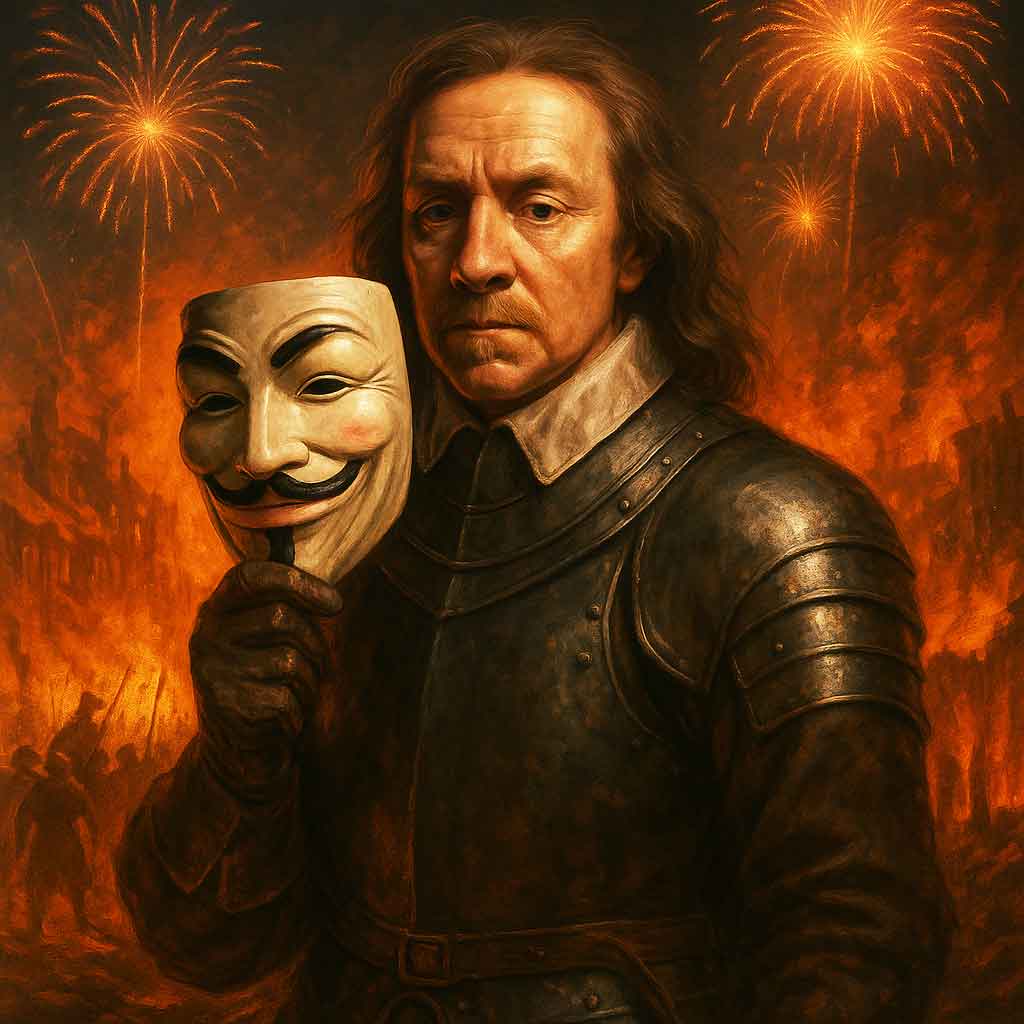
Bonfire Night is one of the strangest survivals in English public life: a piece of state propaganda, personally ordered by a king, which has been re-issued, rebranded, and re-weaponised by every generation since - Stuart, Hanoverian, Victorian, and now twenty-first-century - usually against whichever religious or ethnic minority happened to be convenient at the time. It has been used to celebrate the frustration of a Catholic plot, and then, eighty-three years later, quietly rewritten to celebrate a Dutch prince’s invasion. It gave England its first taste of organised party politics. And it is still, on occasion, being used exactly as it was designed: as a ritual for burning an enemy in public.
This is that history - assembled from the antiquarian folklorists who recorded the bonfires, the churchmen who preached over them, and the historians who have spent the last thirty years working out who was actually pulling the strings.
Before Gunpowder: What Even Is a “Bonfire”?
The word predates the Plot by centuries, and antiquarians have never fully agreed on where it comes from. The older, and more romantic, theory holds that “bonfire” is a corruption of “bone-fire” - a fire built, quite literally, of bones, associated with ancient midsummer and funerary rites where the remains of animals (and, in the darker versions of the story, of martyrs) were burned in the open. The Victorian folklorist T. F. Thiselton-Dyer offers a gentler rival theory in British Popular Customs: that a bonfire was originally a “boon-fire” - one built from boons, meaning fuel contributed as gifts of communal, charitable feeling, with neighbours pooling wood for a shared blaze.
Either etymology points to the same underlying fact: long before 1605, English communities already lit large communal fires at fixed points in the calendar - Midsummer Eve, and especially Hallowmas, the older name for the season around Halloween and All Souls’ Day, when bonfires and “souling” (begging door-to-door for soul-cakes) were already well established. This matters enormously for what comes next, because when the Gunpowder Plot handed the English state a new date to fill with fire, it didn’t have to invent a bonfire tradition from scratch. It only had to redirect one that already existed. As the folklorist G. F. Northall put it bluntly in English Folk-Rhymes: “The Hallowmas bonfires seem in England to have been annexed by Guy Fawkes’ Day.” A children’s rhyme collected at Baschurch, Shropshire, shows the join in the seam, fusing the old Hallowmas begging-cry directly onto the new one: “Soul! soul! for a lump of coal, / A stick and a stake for King George’s sake.”
1605: The Plot, and the King Who Weaponised It Immediately
The bones of the story are familiar. By 1605, English Catholics had endured decades of fines, exclusion from public office, and intermittent persecution since Henry VIII’s break with Rome. A group of disaffected Catholic gentry - led by Robert Catesby and including a veteran Spanish-army soldier and explosives expert named Guido “Guy” Fawkes - planned to detonate 36 barrels of gunpowder beneath the House of Lords during the State Opening of Parliament, killing King James I, his heir, and the assembled Lords and Commons in one stroke, to trigger a Catholic uprising.
The plot unravelled through an anonymous tip-off - a letter warning Lord Monteagle to stay away from Parliament, containing the cryptic line that “the danger is past, so soon as you have burnt the letter.” James I himself is credited with the correct reading: that gunpowder, not fire, was the threat. Searchers found Fawkes in the cellar just after midnight on 5 November, “a dark lantern, a tinder-box, and three matches” on his person, and - as William Hone’s Every-Day Book records with relish - Fawkes, far from repentant, “boldly said, if he had been taken within the cellar, he would have blown up himself and them together.” Eight conspirators were eventually executed; two Jesuit priests, Garnet and Oldcorne, went to the scaffold alongside them for allegedly knowing of the plot in advance.
Here is where the popular story usually stops - and where it gets the origin wrong. It’s widely assumed that Parliament created Bonfire Night, via the “Observance of 5th November Act” passed in January 1606. New archival research by the historians Philip Williamson and Natalie Mears, published in The Historical Journal in 2021, overturns this. They uncovered earlier royal orders predating the Act and showed that the annual thanksgiving was initiated not by Parliament, but by King James I himself - who additionally instructed the bishops to hold regular mid-week commemorations throughout England and Wales, not merely a single annual service. Crucially, Williamson and Mears also show the thanksgivings were never a purely English affair: they were ordered in Scotland too, and observed in Protestant churches in Ireland - a British, dynastic project from day one, not the narrowly “English national” story usually told. The 1606 Act itself, on this reading, wasn’t the birth of the holiday at all - it was a political skirmish between the king and an assertive House of Commons, layered on top of a commemoration James had already set in motion.
So Bonfire Night’s very first form was not spontaneous popular celebration. It was a piece of dynastic religious policy, issued from the top, with compulsory attendance written into law: the Act required “all and every person and persons inhabiting within this Realme of England… [to] always upon that day diligently and faithfully resort to the Parishe Church or Chappell accustomed.” Missing church on the 5th of November was, for two and a half centuries, against the law.
The Sermon Machine: Bishop Andrewes and the Politics of Providence
The Crown didn’t just legislate the holiday; it staffed it. Lancelot Andrewes, Bishop of Ely and later Winchester, preached the official Gunpowder Treason sermon before the King at Whitehall in an almost unbroken sequence from 1606 into the 1620s - a state ritual as fixed as the Trooping of the Colour. We know from a surviving letter that in 1612, when Prince Henry’s death interrupted the pattern, the diarist John Chamberlain still turned up: “Going the next morning, the 5th of November, to hear the Bishop of Ely preach at court… I found by the King and Queen’s absence from the sermon… how the case stood.” The show, in other words, was expected to go on regardless.
These sermons did real ideological work. Andrewes’s circle drew explicit comparisons between the Gunpowder Plot and the St Bartholomew’s Day Massacre in France, cast the Jesuits as having “justified” the plot “as lawful,” and framed James’s escape in unambiguously providential terms - God had personally intervened to protect a Protestant king and a Protestant nation. This was the theological machinery already in place - proof by precedent that God took sides, and that 5 November was the date He’d chosen to prove it - decades before anyone needed to explain a second miracle.
Pope Day: How the Plot Became a Political Weapon
Through the seventeenth century, the anniversary hardened into something closer to a loyalty test. Effigies of the Pope, not Guy Fawkes, were the original target of the flames - the day was frequently just called “Pope Day.” That instinct reached its most dangerous point during the Exclusion Crisis of 1678–1681, when the ex-clergyman Titus Oates fabricated a “Popish Plot” to assassinate Charles II, triggering a wave of hysteria that saw at least 22 innocent Catholics executed on fabricated evidence. For several years afterwards, 5 November became a set-piece in the parliamentary fight over excluding Charles’s Catholic brother James from the succession. Whig activists staged enormous, theatrical Pope-burning processions through London in 1679 and 1680, complete with effigies of the Pope, Jesuits, and sometimes James himself - pageantry so elaborate it helped crystallise England’s first real party system, Whig against Tory, each side fighting over the memory of 1605.
It’s worth noting that even after the immediate crisis passed, this habit of embodying the year’s chosen enemy in an effigy proved endlessly adaptable. A “Pope-day” rhyme recorded by Northall shows the process of accretion in real time - a Georgian-era verse about burning “Pope, Pope, Spanish Pope” with a later line simply bolted on for the news of the day: “And a rope and a cart, / To hang Bonyparte.” The ritual was a container; whoever the enemy happened to be that decade, the fire was already there waiting for them.
1688: The Second Deliverance
And then, eighty-three years after Guy Fawkes was dragged out of that cellar, England’s luck repeated itself - or appeared to.
On 5 November 1688, William of Orange, the Protestant husband of James II’s own daughter Mary, landed his invasion fleet at Brixham in Torbay, beginning the Glorious Revolution that would depose the Catholic James II within weeks. According to Bishop Gilbert Burnet, who was aboard the fleet, this was not a lucky coincidence that got noticed after the fact - it was, per a footnote added by the antiquarian editor Henry Ellis to Brand’s Observations on Popular Antiquities, “the particular wish of his partizans that he should defer his landing till the day the English were celebrating their former deliverance from popish tyranny.” Contrary winds had already delayed the fleet by several days; whether the final date was providence, propaganda, or simply convenient timing was already being argued over within a generation.
Whatever the truth of the timing, William’s regime moved fast to claim it. The historian Tony Claydon, in his study of Williamite court propaganda, shows that “before the new government’s first Gunpowder Day, the official reason given for its observance was altered to make it a day of gratitude for William’s deliverance, as well as 1605.” We don’t have to take Claydon’s word for the wording alone - William Hone’s Every-Day Book quotes the amended Book of Common Prayer service directly, and it is remarkably explicit: a “Form of Prayer with Thanksgiving, to be used yearly upon the Fifth day of November; for the happy deliverance of King JAMES I… from the most Traiterous and bloody-intended Massacre by Gunpowder: And also for the happy Arrival of His late Majesty (King WILLIAM III.) on this Day, for the Deliverance of our Church and Nation.”
Burnet himself preached the first version of this dual message to the House of Lords in 1689, in a sermon whose full title says everything: “A sermon preached before the House of Peers in the Abby of Westminster on the 5th of November, being the gunpowder treason day, as likewise the day of His Majesties landing in England.” Throughout the 1690s, court preachers folded 1688 into an established genre - a running “catalogue of divine mercies” that already included the death of Mary Tudor and the failed plots against Elizabeth I. Each generation’s crisis got slotted into the same providential narrative, and 5 November, uniquely, was the one date flexible enough to carry two entirely different deliverances at once. It is genuinely accurate to describe the day, from 1689 onward, as a commemoration of a double deliverance from Catholicism - a phrase used independently by multiple modern historians describing exactly this dual-thanksgiving structure.
The same theological DNA - a Protestant nation providentially rescued from Catholic power by the arrival of William of Orange - produced a second, separate commemorative bonfire tradition across the Irish Sea. Northern Ireland’s “The Twelfth” marks the Williamite victories at the Boyne (1690) and Aughrim (1691), and is preceded every year by “Eleventh Night” bonfires. The Twelfth isn’t a copy of English Bonfire Night, and the two traditions commemorate different events on different dates - but they are, in every meaningful sense, siblings: both use fire as the ritual proof of a providential Protestant victory, and both were built up with active institutional sponsorship rather than growing purely from folk custom. And, as with the English tradition, the ritual has shown it can just as easily take a present-day “enemy” as a seventeenth-century one: in July 2025, an Eleventh Night bonfire at Moygashel, County Tyrone, was built with mannequins in life jackets arranged in a boat alongside placards reading “stop the boats,” in an unmistakable reference to migrants crossing the English Channel. The display drew condemnation from politicians across the political spectrum, church leaders, and Amnesty International, and prompted a hate-incident investigation.
The Georgian Bonfire: Riot, Ritual, and Regional Rhyme
By the eighteenth century, the anniversary’s religious solemnity was fraying into something rowdier, more local, and - frankly - much more fun to read about. The antiquarian record from this period is a patchwork of regional customs, each with its own rhyme:
In London, the Lincoln’s Inn Fields bonfire was a civic spectacle in its own right - “upwards of two hundred cart-loads” of fuel, according to Dyer’s British Popular Customs, feeding a blaze on which “more than thirty ‘guys’ were burnt upon gibbets between eight and twelve o’clock at night.” Nearby, the butchers of Clare Market staged a grim little pageant of their own: one of their number, dressed as Fawkes, was drawn through the streets in a cart with a mock priest and executioner in attendance, while other butchers led the way “ringing peals from marrow-bones-and-cleavers.”
Out in the counties, the same skeleton rhyme mutated endlessly by dialect and local grievance. Derbyshire children begged: “Pray gi’s a bit o’ coal, / Ter stick in th’ bun-fire hole!” At Purton in Wiltshire, boys went door to door for weeks collecting faggots, warning: “If you don’t give us one, / We’ll take two.” At Marlborough, revellers formed a ring around the fire and beat sticks held over each other’s shoulders “all shouting and screaming loudly… till the fire died out.” A Kirkby Stephen rhyme recorded in the Denham Tracts even preserves a fragment nobody - including the folklorist who wrote it down - could explain: a mysterious refrain about “Queen Mary’s daughter,” which the reciting lad could only shrug off with “Aw larnt it sae, and aw knaw na mair” (I learnt it so, and I know no more). Folklore doesn’t always resolve into tidy meaning; sometimes it just survives.
Yorkshire contributed something less flammable and more edible: Parkin, a dense oatmeal gingerbread still baked in the region every 5 November. Elsewhere, the day supplied roast chestnuts, treacle toffee, toffee apples, baked potatoes pulled straight from the embers, and bowls of pea soup - the beginnings of the food-focused, family-oriented version of the night that eventually won out.
It wasn’t always genial. The University of Southampton’s special collections record serious disorder breaking out at Lewes in 1785 and Southampton in 1788, evidence that by the late Georgian period the 5th of November had also become a night when “the usual standards of behaviour were relaxed and authority could be challenged” - a licensed night of misrule as much as a religious commemoration.
From “Gunpowder Treason Day” to “Guy Fawkes Day”
Two developments in the nineteenth century finally drained the anniversary of most of its anti-Catholic charge. The Catholic Relief Act of 1829 restored civil rights to Catholics; then, in 1850, Pope Pius IX re-established the Catholic diocesan hierarchy in England, an act that briefly provoked a fresh (and now rather anachronistic-looking) wave of “No Popery” outrage - one 1850 political cartoon was literally titled “The Guy Fawkes of 1850.” But the underlying sectarian animus was fading. Catholics were, by now, neighbours and colleagues rather than an imagined fifth column, and the compulsory church service mandated back in 1606 was finally repealed by Parliament in 1859.
The culture caught up with the politics. William Harrison Ainsworth’s bestselling 1841 historical romance Guy Fawkes; or, The Gunpowder Treason - part of a wave of popular fiction romanticising the era - helped shift Fawkes from hate-figure to a more ambiguous, even sympathetic, historical character in the public imagination. The effigy on the bonfire increasingly became “Guy Fawkes” rather than “the Pope”; the day’s very name drifted from “Gunpowder Treason Day” to the more individual, more secular “Guy Fawkes Day,” and eventually to the almost apolitical “Fireworks Night” familiar today.
A Ritual That Never Really Forgot How to Hate
And yet the fire remembers its own design. A bonfire built to burn a chosen enemy in public doesn’t stop being that kind of ritual just because the culture around it moves on - it just waits for someone to reach for it again.
England’s own bonfires have not been immune, and the Sussex bonfire societies - the most direct living descendants of the anti-Catholic torchlight processions recorded by Dyer in the nineteenth century - have provided the clearest example. In October 2003, in the East Sussex village of Firle (part of the same network of bonfire societies as nearby Lewes), a bonfire effigy depicting a caravan painted with figures of women and children and a licence plate reading “P1KEY” - a slur against Travellers - was burned, days after a group of Travellers had been evicted from a field in the area. Twelve people were arrested on suspicion of incitement to racial hatred, though prosecutors later concluded there was insufficient evidence to proceed; the Firle Bonfire Society apologised publicly and cancelled its remaining events for the year. Four hundred years on, the underlying mechanism was unchanged: build an effigy of whoever the community has decided is the current threat, and set fire to it in front of a cheering crowd.
Conclusion: A Fire Lit on Purpose
Bonfire Night likes to present itself as an accident of history - a spontaneous folk memory of a plot that failed. It is nearly the opposite. It was ordered into existence by a king who wanted his subjects preaching sermons about him twice a week; it was quietly rewritten within a single generation to serve an entirely different regime’s propaganda needs; it was fought over in the streets by England’s first political parties; and it has been reloaded, again and again, with whatever enemy - Spanish, French, Irish, Catholic, Traveller, migrant - a given decade found most convenient to burn.
None of that makes an evening of fireworks and baked potatoes with your family sinister. But it’s worth knowing, as you watch the Guy go up in flames this November, that you are looking at one of the oldest, most successful pieces of state media ever produced in England - and that the ritual itself has never once forgotten what it was built to do.
Frequently Asked Questions
Why do we celebrate Bonfire Night?
Bonfire Night marks the failure of the 1605 Gunpowder Plot, in which Guy Fawkes and a group of Catholic conspirators attempted to blow up the House of Lords and King James I during the State Opening of Parliament. The king ordered an annual thanksgiving commemoration almost immediately, and Parliament made it a legal requirement in 1606. From 1689 onward, the same date was also used to commemorate William of Orange’s landing in England, making it a commemoration of two separate events.
What does “Remember, remember the fifth of November” actually mean?
It’s the opening line of a folk rhyme, recorded in dozens of regional variants by Victorian folklorists, that children traditionally sang or chanted while collecting fuel or money for the bonfire. The fullest common version continues: “Gunpowder treason and plot; / We know no reason why gunpowder treason / Should ever be forgot.” Its purpose was explicitly mnemonic - a piece of religious-political propaganda simple enough for children to memorise and repeat.
Is Bonfire Night connected to Halloween?
Indirectly, yes. English communities already lit large communal bonfires at Hallowmas (the older name for the Halloween/All Souls’ season) long before 1605. The folklorist G. F. Northall argued these older Hallowmas bonfires were effectively “annexed” by the new Gunpowder Plot commemoration, and several regional begging-rhymes show the two customs fused together, blending the older “souling” tradition with the newer stick-and-coal collection for the 5 November fire.
Why do people burn effigies on Bonfire Night?
The custom originally targeted the Pope, not Guy Fawkes - 5 November was widely known as “Pope Day” well into the eighteenth century, and elaborate Pope-burning processions became a major political tool during the Exclusion Crisis of 1678–1681. The effigy became specifically associated with Guy Fawkes only later, as the day’s explicit anti-Catholic meaning faded through the nineteenth century.
What is the connection between Bonfire Night and William of Orange?
William of Orange landed his invasion fleet at Brixham, in Torbay, on 5 November 1688 - the same date already marked for the Gunpowder Plot - beginning the Glorious Revolution that deposed the Catholic King James II. Contemporary sources suggest this was not entirely coincidental: William’s supporters reportedly wanted him to land on the anniversary of England’s “former deliverance from popish tyranny.” Afterwards, the official Book of Common Prayer thanksgiving for 5 November was formally rewritten to give thanks for both events, and this dual-commemoration wording remained in official use for well over a century.
Is Bonfire Night the same as Guy Fawkes Night?
Broadly yes, though the names reflect different eras of the same tradition. “Gunpowder Treason Day” was the original, explicitly religious-political name. As anti-Catholic sentiment faded in the nineteenth century, the day was increasingly called “Guy Fawkes Day” or “Guy Fawkes Night,” centring the individual conspirator rather than the sectarian conflict. “Bonfire Night” and “Fireworks Night” are the more secular, modern names now most commonly used.
Why is Bonfire Night connected to Northern Ireland’s Twelfth of July?
They aren’t directly descended from one another - the Twelfth commemorates the Williamite victories at the Battle of the Boyne (1690) and the Battle of Aughrim (1691) in Ireland, on a different date entirely. But both traditions grew from the same underlying belief system: that a Protestant nation had been providentially delivered from Catholic power by William of Orange. Both use bonfires as their central ritual, and both were actively promoted by political and religious institutions rather than emerging purely as folk custom.
When did Bonfire Night stop being a legal requirement?
The Observance of 5th November Act, which made church attendance on the day compulsory, remained law for 253 years before Parliament repealed it in 1859, by which point the religious rationale for the holiday had largely dissolved into a more general, secular celebration.
Did Guy Fawkes actually invent gunpowder?
No - gunpowder was already centuries old by 1605, most likely introduced to Europe via contact with Chinese and Islamic technology. Fawkes was an experienced soldier and explosives handler who had fought in the Spanish army in the Low Countries, which is precisely why the other conspirators recruited him to manage the gunpowder itself.
What traditional foods are associated with Bonfire Night?
Regional customs recorded by Victorian folklorists include Yorkshire parkin (a dense oatmeal gingerbread baked specifically for the occasion), treacle toffee, toffee apples, roasted chestnuts, jacket potatoes cooked in the embers of the fire, and bowls of pea soup - most of which remain familiar Bonfire Night foods today.