Across every civilisation that left records, human beings looked at the invisible force that bent trees, drove ships and brought storms, and named it divine. This is the story of how the world's cultures understood the wind as a god - from the earliest Sumerian clay tablets to the storm hags of the Scottish Highlands.
Introduction: The Sacred Breath
Of all the forces of nature that ancient peoples sought to understand, the wind was in many ways the most theologically troubling. Unlike the sun, it could not be seen. Unlike water, it could not be held. It arrived without warning, carried no visible form, and yet could uproot forests, swamp fleets and transform the world in minutes. That an invisible force could possess such power seemed, to ancient minds, to demand a supernatural explanation.
The result was one of the most widespread and richly varied fields of religious imagination in human history. Every major civilisation from Sumer to Scotland developed wind theologies - complex systems of named, characterised, and ritually significant wind beings ranging from the majestic to the monstrous. What is remarkable, surveying this material from the earliest known texts to the folklore of living memory, is not only the diversity of these traditions but the structural patterns that recur across cultures that had no known contact with one another.
Wind deities, it turns out, tell us something fundamental about how human minds have organised their understanding of power, time, and the cosmos.
I. The First Storm-Lords: Mesopotamia and the Primordial Wind
Enlil: Lord of the Breath Between Heaven and Earth
The oldest named wind deity in any surviving literature is Enlil, the Sumerian god whose name scholars have translated as "Lord Wind," "Lord of the Air," or more fully, "the wind that breathes between heaven and earth." When Sir James Frazer lectured in Edinburgh in 1925, he observed of Enlil that he was "originally an air god" whose great shrine at Nippur - the E-kur, or House of Mountains - functioned as the theological centre of ancient Babylonia. By the time Enlil's mythology was fully developed, he had become, as Frazer recorded, "King of Heaven and Earth and Father of the Gods."
The Sumerian literary corpus gives us Enlil's atmospheric identity in remarkable detail. The hymn Enlil in the E-kur (preserved in the Electronic Text Corpus of Sumerian Literature at Oxford) describes him as "the Wind of the Mountain" who occupied the divine dais and "spanned the sky as the rainbow," moving across heaven "like a floating cloud." His commands are described as immutable not in spite of his wind nature but because of it - wind in Sumerian cosmology was not merely atmospheric but ontological, the breath that makes creation possible and sustains it.
The hymn states plainly that without Enlil, "in the sky the thick clouds would not open their mouths." Weather is not a byproduct of his power; it is his power made visible. When he decrees, barley grows, rivers flood, and "the early flooding, the life of the lands" arrives. This inseparability of divine will and atmospheric effect is the defining characteristic of the earliest wind theology.
Enlil's consort was Ninlil, whose mythology is elaborated in the text Enlil and Ninlil - one of the most extraordinary texts to survive from ancient Sumer. In a narrative that encodes a profound cosmological wind-theology beneath its domestic drama, Enlil impregnates Ninlil with the moon god Suen-Ašimbabbar, then is exiled from the holy city of Nibru as ritually impure. Ninlil follows him. Disguising himself three times as underworld gatekeepers, Enlil generates three further divine offspring - Nergal, Ninazu, and Enbilulu - each born downward into the underworld as cosmic counterweights to the moon's ascent into the sky. The theological logic is elegantly atmospheric: wind generates both celestial light and chthonic darkness, breath animates both the living world and the realm of the dead.
Edward Chiera's 1934 Sumerian Epics and Myths - the primary cuneiform record examined here - preserves the most complete tablet evidence for the Enlil cycle, including a section of the Lugal-e epic devoted to the giš-al of Enlil, a sacred agricultural implement central to Enlil's role as the wind that fertilises land through its moisture.
Ninurta: The Storm That Goes to War
Enlil's son Ninurta inherited his father's atmospheric power but expressed it in a dramatically different register. Where Enlil was the sustaining cosmic breath, Ninurta was the storm weaponised. The opening of Ninurta's Exploits (ETCSL 1.6.2) addresses him as "a roaring hurricane," "hero whose awesomeness covers the mountains like a south storm," and "roaring hurricane" - his storm nature is not metaphorical but constitutive of his divinity.
When Ninurta rides to battle against the monstrous Asag, he travels "on the eight winds" - one of the earliest textual attestations of an eight-point wind cosmology in Mesopotamian literature. He deploys the "evil wind and the sirocco" as weapons, and his sentient mace the Šar-ur is described as having "wings that bear the deluge." The battle produces total atmospheric catastrophe: the Tigris runs muddy, forests are flattened, fish gasp at the surface as the groundwater fails. Only after Ninurta's victory does he restore cosmic order by building a great stone dam to regulate the waters of the mountains. The storm god is also, necessarily, the god who brings the calm after the storm.
Pazuzu: The Wind as Demon
Not all Mesopotamian wind beings were divine patrons. Pazuzu, the lion-headed demon whose image was placed on apotropaic amulets throughout the ancient Near East, represents a completely different wind theology - the wind as plague-carrier, bringer of fever, spreader of pestilence. In 1935, excavations at Rayy in Persia produced a stucco mask identified by Arthur Upham Pope in the Illustrated London News as "recalling the type Pazuzu, the old Mesopotamian wind demon, who was so often depicted for apotropaic purposes even down into the Parthian period (249 B.C. to 224 A.D.)."
Pazuzu's theological function is uniquely paradoxical: he is himself a destructive wind demon, yet his image was used to ward off other wind demons, particularly Lamashtu, the child-killing spirit. The principle is protective homeopathy - the demon of the southwest desert wind, who brings drought, locusts and fever, is sufficiently powerful to repel lesser wind-born evils. This apotropaic wind-demon tradition, absent from the Sumerian literary texts, represents a distinct layer of Mesopotamian wind theology operating in the practical domain of daily magical practice.
II. Egypt's Cardinal Winds: The Four Guardians
Shu: The Atmosphere Deified
Egyptian wind theology is most clearly visible in two registers: the cosmological and the directional. At the cosmological level, Shu - the god of air and atmosphere - occupies a position analogous to Enlil's in Sumer. He is the animating breath of the cosmos, the space between earth and sky that makes both habitable. The image preserved in E. A. Wallis Budge's Gods of the Egyptians (Vol. 2, 1904) of Shu lifting the sky-goddess Nut from the earth-god Geb - holding the heavens aloft with his own body - is the defining icon of Egyptian atmospheric theology. Without Shu there is no sky, no weather, and no life.
The Four Wind Gods: Cardinal Guardians of the World
At the directional level, Egypt developed one of the most precisely organised wind taxonomies in ancient religion. The four cardinal wind gods are described and illustrated in Budge's monumental study (Chapter XIX, Section VIII, "The Gods of the Four Winds"), and their iconographic forms were preserved in temple art and on sacred objects throughout the dynastic period.
A remarkable confirmation of this tradition appeared in 1911, when the British Museum acquired a limestone obelisk fragment from Sais - dated to around 800–650 BCE - whose four faces displayed the four wind gods in relief. As the Globe reported at the time, "the four sides are ornamented with reliefs representing the four wind gods in the forms of a winged hawk, two winged rams, and a winged scarab. These reliefs, which are the emblems of the gods Keb, Shehbui, Henmusheses, and Herutchai, and represent north, south, east, and west respectively, were, like the hieroglyphs which accompany them, painted in blue and bright red."
Budge's own text gives us the full iconographic programme. Qebui, the North Wind, appears as either a man with four ram heads or as a four-headed winged ram - his multiplicity of heads suggesting the wind's capacity to blow in all northern directions simultaneously. Shehbui, the South Wind, is a winged human figure with a lion's head and the four-feathered crown of dominion. Henkhisesui, the East Wind, takes either the form of a winged ram-headed scarab or a winged ram-headed man - the scarab linking the east wind to the rising sun that it accompanies. Hutchaiui, the West Wind, is a winged serpent-headed man, his snake's nature suggesting the dangerous, unpredictable quality of the westerly Atlantic air.
The theological significance of this system cannot be overstated. The Egyptian four-wind framework is not merely directional organisation but a cosmological claim: the world has four quarters, each animated by a named, characterised, and visually distinct divine being. To know the wind is to know one of the gods.
An Egyptian religious text translated by R. T. Rundle Clark and reviewed in the Birmingham Daily Post in 1960 gives us the most direct statement of wind's theological importance in Egyptian religion. In it, the Universal Lord speaks of four great benefactions to creation: "I made the four winds that every man might breathe thereof, wherever he might be." Wind here is explicitly a democratic gift - unlike the Nile flood or the harvest, the wind belongs equally to the powerful and the poor.
III. The Hebrew Ruach: Breath, Spirit and Storm
The Hebrew Bible's treatment of wind sits at the intersection of Mesopotamian influence and the monotheistic reflex against divine personification. The word ruach - translated variously as wind, breath, or spirit - appears from the very first verse of Genesis, where the ruach elohim moves upon the face of the waters before creation begins. Wind here is not a deity but the animating breath of the one God, the creative force that will become pneuma in Greek and spiritus in Latin theology.
Yet traces of the older, polytheistic wind theology are visible. The Book of Job speaks of the divine command over the winds with a specificity that implies the older tradition of wind as named supernatural agent: "I keep the winds in awe with my hand vast as in the air," as one ancient paraphrase preserved in seamen's lore has it. The four corners of the earth - an implicit directional wind cosmology - appear repeatedly in prophetic literature. And in the broader Semitic tradition, wind demons retained their hold on popular imagination well into the rabbinic period: Talmudic tradition assigned eight angels, subject to Solomon's will, as rulers of the winds.
The Tower of the Winds in Athens
IV. The Athenian Wind Rose: Greece's Wind Theology
Aeolus: The Wind-Keeper
The Greek tradition is distinguished from all others by its sophisticated differentiation between the custodian of winds and the winds themselves. Aeolus - whose home on the floating island of Aiolia was still visible, according to the Sketch magazine in 1957, in the Aeolian Islands north of Sicily, "where Aeolus, the god of the winds, had his home, and Ulysses came on his travels" - is not a wind deity in the elemental sense. He is a keeper, a warden, a prison governor of the winds.
The tradition is ancient and explicit. As Captain Thomas Smith recorded in the Portsmouth Times in 1913, drawing on Virgil's Aeneid: "Where Æolus is king of all avail, / And far adown a cavern vast the bickering of the winds / And roaring tempests of the world with bolt and fetter binds." Aeolus sits in his island fastness, releasing winds at the command of the Olympian gods. When he gave Odysseus a bag containing the adverse winds, sealed so that only the favourable west wind remained free, he was performing what the ancient world understood as the fundamental act of wind governance: imprisonment and controlled release.
The 1890 Globe article on wind gods noted the structural parallel elegantly: "Æolus with the winds imprisoned in his cave has the same office as Woden, controller of the winds, the Iroquois 'Gäoh,' the spirit of the winds or the great Polynesian deity, Maui, all of whom hold supreme power over the wind gods themselves." The imprisoned wind released by divine command is one of the most cross-culturally persistent mythological structures.
The Anemoi: Four Winds, Four Seasons
The four directional winds of Greece - the Anemoi - present a remarkably different theology from their Egyptian counterparts. Where Egypt's four wind gods are cosmic guardians of the world's cardinal structure, Greece's Anemoi are seasonal beings, each associated with a specific time of year as much as a direction.
According to Hesiod's Theogony, which the scholar Kerényi relied upon in his Gods of the Greeks (1951), the Anemoi are children of Eos (Dawn) and Astraios (the starry sky) - born from the union of morning light and the heavens, a genealogy that makes atmospheric sense: dawn is the moment when winds are born, when the day's first breeze stirs from the cooling night air. Boreas the North Wind brings winter; Zephyros the West Wind brings spring's gentle warmth; Notos the South Wind arrives with late summer storms; and Euros the East Wind governs autumn.
As the Morpeth Herald recorded in 1888, drawing on classical sources, Boreas was a particularly vivid mythological figure: "a cave of the Thracian Haemus, to which he carried Oreithyia, the daughter of the Athenian King Erechtheus." The rape of Oreithyia was, in Athens, a politically significant myth - when Boreas destroyed the ships of Xerxes before the Persian Wars, the Athenians built him a temple on the river Ilissos in gratitude, making their wind god simultaneously a patriotic patron. He received annual festivals at Megalopolis, and his sons Zetes and Calais joined the Argonauts as winged heroes. The North Wind was not merely atmospheric but ancestral.
Kerényi's analysis in Gods of the Greeks also establishes a crucial theological distinction that other sources often collapse: Hesiod and Homer carefully separated the Anemoi - the four seasonal wind gods, relatively benign - from the Thuellai, the violent storm-winds born of the monster Typhoeus. The latter were not divine patrons of seasons but destructive chaos agents, kept imprisoned in Tartaros or Aeolus's cave to be released only at divine command. The Harpies - those bird-women storm spirits who swoop upon the food of King Phineus - occupy the older, darker layer of Greek wind mythology, descending from the sea-god Thaumas and the Oceanid Electra, sisters to Iris the rainbow. As Hesiod describes them, they "keep pace with the blowing winds, or birds in flight, as they soar and swoop, high aloft."
The Tower of the Winds: Mythology Made Architecture
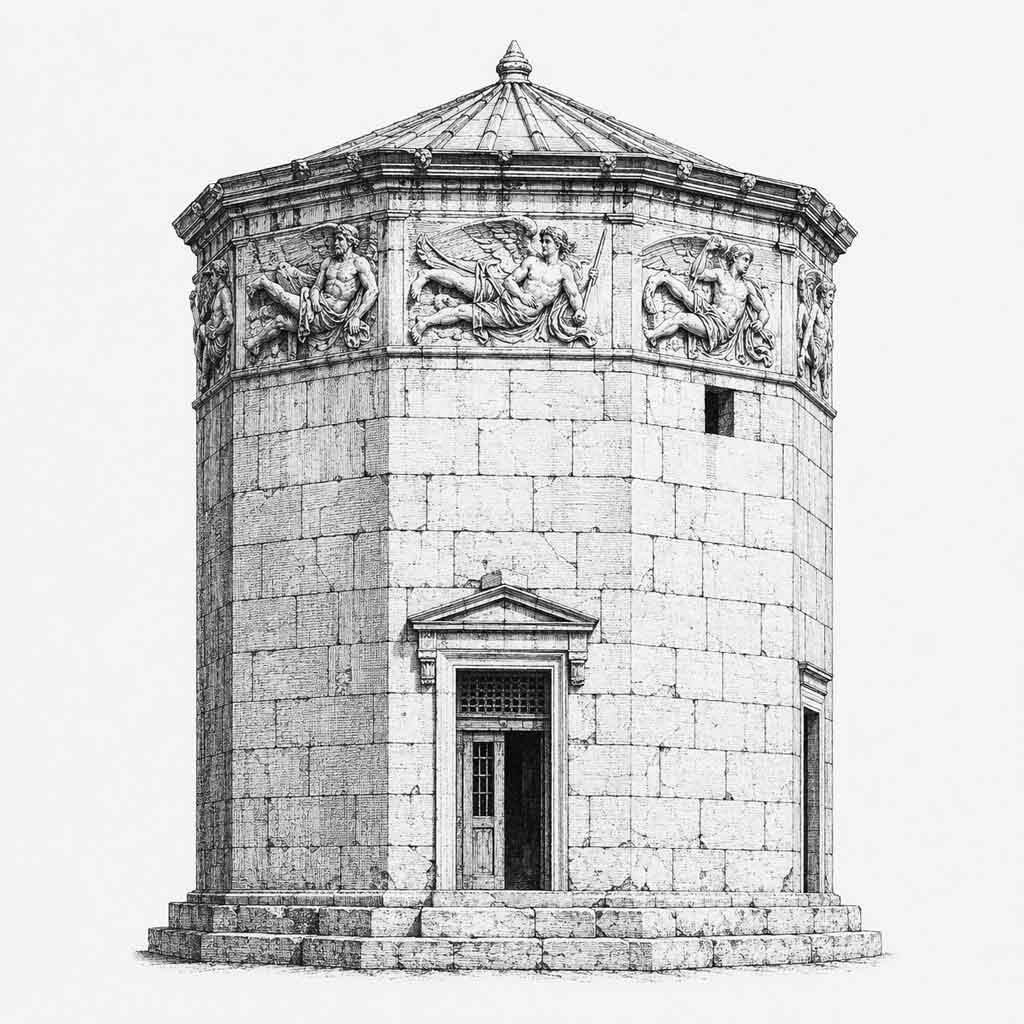
Perhaps no ancient monument better illustrates how wind theology became civic knowledge than the Tower of the Winds in Athens, built around 100 BCE by Andronikos of Kyrrhos. As described by the Illustrated London News in 1946, "on each face of the tower are portrayed the personified wind, each figure significant of the kind of weather brought by the wind it represents." The figure of Notos, the south wind, empties a jar of water - correctly identifying the south wind as the wet wind associated with approaching depressions. The Sketch's description from 1873 captured the tower's wind-by-wind iconography: Boreas blowing a twisted cone, Zephyros scattering flowers, Euros threatening with a muffled arm, Notos pouring rain from a swelling vessel.
The tower's figures are, as meteorologists would later observe, arranged in counter-clockwise order - precisely the direction in which winds circulate around a low-pressure system in the northern hemisphere. Whether this reflects conscious meteorological knowledge or fortuitous alignment with natural order, the Tower of the Winds stands as the most systematic wind deity monument in the ancient world.
V. The Vedic Tempest: India's Storm Gods
The connection between Greek and Indian wind theology is one of comparative religion's most striking demonstrations of shared Indo-European inheritance. The Maruts - the storm and wind gods of the Vedic hymns, described in the Kensington News in 1889 as beings who "fling the clouds hither and thither" - are a group of between twenty-seven and sixty storm gods, sons of the great sky god and companions of Indra.
Sir William Jones, the eighteenth-century founder of comparative linguistics, observed in his Gods of Greece, Italy and India (written 1784, examined here in its 1876 reprint) that Indra, the king of the Vedic gods, is specifically "the regent of winds and showers." His residence, Amaravati, his charioteer Matali, and his weapon the Vajra thunderbolt all mark him as the fully realised storm sovereign - the Indian parallel to Zeus as Enlil's Hellenic equivalent. Jones noted that Indra's celestial city oriented to the East, connecting the king of winds to the east wind's dawn cosmology established in Hesiod.
Vayu, the dedicated wind god of the Vedic and Hindu traditions, represents the direct atmospheric deity - the wind as divinity in its purest form, born from the breath of the supreme cosmic being. The Portsmouth Times in 1914 recorded the Zoroastrian parallel: "Zoroaster believed in the wind-carrying spirit, Vato or Vayu; a friendly evil one" - the Iranian equivalent of the Vedic wind god carrying the same ambivalence between beneficent and destructive wind that characterises the atmospheric divine throughout the ancient world.
VI. Norse Wind Theology: The Keeper and the Wanderer
Njörðr and the Vanir
Norse wind theology operates on two distinct levels: the specific and the cosmic. The specific is provided by Njörðr, the Vanir sea-god whose primary atmospheric function is stated precisely in the Prose Edda and analysed by Finnur Jónsson in his 1913 Icelandic study Goðafræði Norðmanna og Íslendinga. Njörðr, Jónsson notes, is specifically described as the god who "rules over the course/path of the wind and stills sea and fire" - making him simultaneously a wind controller, a sea ruler, and a fire pacifier, the complete maritime meteorological deity.
The evidence from Jónsson's text is revealing. Njörðr's residence is named Nóatún - "the ship-enclosure" or boat-yard - and the place-name evidence from coastal Norway, Iceland, Denmark and Sweden (Njarðey, Njarðvík, Njarðarheimur) confirms that all places bearing his name are by the sea. His marriage to the mountain-goddess Skaði and its breakdown provides Norse mythology's most vivid expression of the atmospheric/terrestrial opposition: Njörðr cannot sleep in the mountains because wolves howl there when he is accustomed to the song of swans; Skaði cannot sleep by the sea because of the screaming of the seabirds. The wind-and-wave soundscape is Njörðr's natural environment, as alien to the mountain goddess as silence is to the sea.
Jónsson's most original philological contribution concerns the relationship between Njörðr and Nerthus, the Germanic earth goddess described by Tacitus in Germania - a goddess of fertility rites whose name is phonetically identical to Njörðr. Jónsson argues that the u-stem word (nerðu-/njörðr) was originally of common gender, functioning as both feminine and masculine, and that the cult of Nerthus represents the original feminine form of the same deity - an earth-and-weather goddess paired with a sky god (Týr), before the shift to a masculine wind deity occurred in the Scandinavian tradition.
As the National Reformer recorded in 1863 in its account of Scandinavian mythology, the broader Norse cosmology assigned cardinal guardianship to four dwarfs placed at the corners of the sky: East, West, North and South - the same four-wind directional system found in Egypt, Greece and Sumer, here embedded in the creation myth itself.
Odin as the Great Wind
At the cosmic level, Odin functions in Norse tradition as the supreme atmospheric deity - the wind that contains all other winds. As the Globe observed in 1890, "to the Teutonic peasant the raging of the storm among the forest trees is still spoken of as 'Odin faring by.'" The legend of the Wild Huntsman - Odin leading a spectral host across the winter sky - is a mythologised expression of the howling gale, and the Portsmouth Times in 1914 recorded that "Carinthian and Bohemian peasants also would not go out of doors for the wind god in gales, saying: 'There, owd then hast for thy child, but thou must be off.'"
The connection between wind and soul in Norse thought was particularly deep. The same Portsmouth Times piece noted that "storm were said to be the souls of women who died" and that Odin's train of storm-spirits included the souls of the restless dead - the belief that wind was the medium through which spirits moved being one of the oldest and most universal of animist conceptions.
VII. Celtic Storm Sovereignty: The Cailleach and Her Named Winds
The Old Woman of Winter
If Norse mythology gives us wind as the wandering god, Celtic tradition - specifically the Gaelic mythology of Scotland and Ireland - gives us something unique in the global record: wind as the expression of a female sovereignty figure, a hag-queen whose emotional states generate specific, named atmospheric events.
The Cailleach - whose name means simply "old woman" or "hag" - is the winter sovereign of Gaelic Scotland, described in the Northern Scot in 1928 as the subject of more place-names in the Western Highlands "than perhaps any other." Sorita d'Este and David Rankine, in their 2009 study Visions of the Cailleach, drawing on Florence McNeill's The Silver Bough, identify the class of "Cailleachan or storm hags, who together represent the elemental forces of nature, particularly in a destructive aspect" - making the Celtic wind tradition simultaneously individual (the Cailleach as singular figure) and collective (the Cailleachan as a class of storm beings).
Her atmospheric functions are extensive. She controls maritime weather, creating violent storms in tidal lochs whenever the mood takes her. The sailors of Cromarty called her "Gentle Annie" in a classic act of propitiatory naming - as d'Este and Rankine note, they "perceived the sudden storms in the Forth as being tricks played by the Cailleach who could control the weather." She predicts the weather through reading animal signs. She summons thunder, wielding the title Cailleach Vearor Vera - the Old Wife of Thunder - in the parish records of Stralachlan, where a standing stone of that name was believed to command thunder and catastrophic rainfall.
Most significantly for comparative mythology, her primary seasonal act - washing her great shawl in the Corryvreckan whirlpool - generates a full meteorological cycle. As the Northern Scot recorded from living tradition: "Before the washing the roar of a coming tempest is heard by people on the Argyleshire coastline of twenty miles, and for a period of three days before the cauldron boils." When the washing is complete and the plaid laid white upon the mountains, winter has officially begun.
Beira's Battle: The Most Detailed Wind Taxonomy in Celtic Mythology
Donald Mackenzie's 1917 Wonder Tales from Scottish Myth and Legend contains what is, for comparative purposes, the most extraordinary wind text in Celtic literature: a catalogue of individually named, characterised and temporally bounded winds deployed by the winter goddess Beira (the Scottish form of the Cailleach) in her seasonal battle against the spring god Angus.
The named winds appear in sequence as Angus repeatedly returns to Scotland to rescue the spring maiden Bride, and Beira responds each time with a new atmospheric weapon:
The Whistle is the first: high and shrill, bringing rapid showers of cold hailstones, lasting three days and killing sheep, lambs, horses and cattle across Scotland. Its name is purely onomatopoeic - the sound of the gale itself.
Gobag - the Sharp-Billed Wind follows: lasting nine days, it "pecked and bit in every nook and cranny like a sharp-billed bird." The Gaelic gob (beak, bill) names a wind by its action rather than its direction. No shelter could exclude it. This zoomorphic characterisation - a wind that behaves like a hunting bird, penetrating every crevice - is structurally parallel to the bird-form wind beings documented in Egyptian and Greek mythology, but here the wind itself possesses the bird's nature.
The Sweeper - the Eddy Wind comes third: its "whirling gusts tore branches from the budding trees and bright flowers from their stalks." This is explicitly a vortex or whirlwind, rotationally structured rather than directional - the small primroses survived in sheltered nooks that its circular energy could not reach. Simultaneously, Beira beat the ground with her magic hammer, suppressing grass growth as the wind tore at the canopy above.
The Gales of Complaint are the fourth wind: sustained through the first week of March, destroying fodder stacks, scattering them over the lochs and ocean, and killing livestock from starvation. Their name - complaint - anthropomorphises the atmospheric force completely. These are aggrieved winds, giving voice to Beira's fury.
The catalogue concludes with the Big Black Tempest and then the Three Hog Days - three tempest spirits who arrive "mounted on black hogs," released from supernatural bondage to wreak three final days of devastating cold. "Long have you been bound! Now I set you at liberty," Beira tells them. The imagery of imprisoned wind-spirits released by divine command connects directly to the Aeolian tradition and the Mesopotamian storm-winds locked in Tartaros - the constraint and controlled release of atmospheric force being, apparently, one of wind mythology's most universal structures.
Mackenzie's text confirms that these wind names were not purely literary inventions. He records in his introduction that "Gaelic-speaking people still refer to certain gales in February and March by their ancient names - the 'whistling wind', the 'sweeper', and so on" - and that non-Gaelic-speaking fisher communities on the north-east coast continued to attribute fierce spring gales to the storm-wife they called "Gentle Annie." The named-wind tradition was a living folk calendar, dividing the dangerous transitional season into identifiable, manageable periods, each with its known character and duration.
VIII. Comparative Patterns: What Wind Deities Tell Us
Surveying this vast material - from Sumerian hymns to Scottish folklore, from Egyptian temple reliefs to Norse sagas - several structural patterns emerge that illuminate something fundamental about human religious imagination.
The imprisoned wind is perhaps the most persistent. From Aeolus's cave to the Hog Day spirits in Beira's keeping to the Mesopotamian storm-winds in Tartaros, the idea that wind must be bounded, constrained, and controlled by divine authority appears across cultures with no known contact. The wind's unpredictability made freedom its defining characteristic; its danger made imprisonment a theological necessity.
Wind as divine mood is equally widespread. The Corryvreckan whirlpool's sounds reflect the Cailleach's emotional state; Beira's named winds are expressions of increasing fury; Enlil's atmospheric decrees are the projection of his will into the physical world. This collapse of the distinction between weather and divine psychology is not primitive confusion but a sophisticated framework in which atmospheric changes carry moral and spiritual information about the state of the cosmos.
The directional taxonomy appears independently in Egypt, Greece, Mesopotamia, Algonquin North America, and Chinese tradition. The East Kent Gazette in 1884 recorded China's version with striking specificity: "That at Leng Shan, in the northern province of Chihli, is the most remarkable. It has a cave at each of its four sides. The spring wind issues from the cave on the eastern side, the summer wind from the southern, and so for the others." The four-sided mountain producing four seasonal winds is structurally identical to the Egyptian four cardinal wind gods and the Greek Tower of the Winds, suggesting that the four-wind cosmology may reflect universal human intuitions about space, time and atmosphere rather than any specific cultural transmission.
Wind and soul form the deepest and most enduring connection. The Globe's 1890 article on wind gods observed that "in the early and primitive idea of the soul as the breath that issues from the lips of man a sacred significance was attached to the wailing of the wind, especially at night when ghosts do walk." The Hebrew ruach, the Greek pneuma, the Latin spiritus, the Sanskrit prana - in every major Indo-European language, the word for wind is also the word for breath is also the word for spirit. This is not coincidence. It is the trace of a primordial insight: that the force which animates living bodies and the force that animates the atmosphere are, at some deep level, the same.
The gendered wind is the final pattern, and perhaps the most culturally variable. Most traditions produce male wind deities - Enlil, the Anemoi, Njörðr, the Maruts - while the Celtic tradition uniquely foregrounds female storm sovereignty in the Cailleach and her Cailleachan. The contrast is theologically instructive: in Celtic thought, the destructive winds of winter are wielded by a queen whose power wanes before the gentle spring god. Wind here is not merely atmospheric but gendered sovereignty - the struggle of seasons made mythological.
IX. The Living Tradition: From Cult to Custom
Wind worship did not end with the ancient world. The South Bank Express in 1928 recorded the curious Kent custom of "Youling" - "making incantations in orchards, after the fashion of the heathen who supplicated Eolus for his favourable breezes" - in which youths visited orchards during Rogation Week, chanting to ensure a good harvest. The very word "youling," the article suggests, perpetuates the wind god's name.
The Scottish tradition of paying propitiary tribute to Bessie Millie - an elderly woman in the Shetland Islands who sold winds to mariners in the early nineteenth century, recorded by Sir Walter Scott - brings the chain from Aeolian mythology to documented early modern practice. Her fee of sixpence secured, she "boiled her kettle and gave the bark the advantage of her prayers" - the direct descendant, across three millennia, of the sacrifices offered to Boreas before the Battle of Artemision.
Conclusion: The Wind Still Blows
Writing in 1890, the anonymous author of the Globe's essay on wind gods concluded with a remark that has lost none of its resonance: "And still the wind bloweth where it listeth, and we hear the sound thereof, but not even the Meteorological Office tells us satisfactorily whence it cometh or whither it goeth."
From the first Sumerian hymns to Enlil in the third millennium BCE to the last living traditions of the Cailleach in the Scottish Highlands, human beings have perceived in the wind something that demanded more than a physical explanation. It moved without visible cause. It arrived without warning. It carried the voices of the dead and the seeds of the living. It could be gentle as the breath of a sleeping child or violent enough to shatter a fleet. And so they named it, characterised it, confined it in theological frameworks, sent prayers and offerings to it, and told stories about it that lasted for four thousand years.
The gods of the wind are not a relic. They are a record - of how human minds grapple with the invisible, the powerful, and the uncontrollable. In the Cailleach's named gales, in Enlil's cosmic breath, in the Tower of the Winds standing yet in Athens, in the four carved figures on an obelisk fragment in the British Museum, the same fundamental insight persists: the air we breathe is sacred. The wind that moves it is divine.
Further Reading and Primary Sources
- Budge, E. A. Wallis. The Gods of the Egyptians, or Studies in Egyptian Mythology, Vol. 2. Methuen & Co., London, 1904.
- Chiera, Edward. Sumerian Epics and Myths (Cuneiform Series III). Oriental Institute Publications Vol. XV. Chicago, 1934.
- Electronic Text Corpus of Sumerian Literature (ETCSL). Faculty of Oriental Studies, University of Oxford. https://etcsl.orinst.ox.ac.uk
- d'Este, Sorita and David Rankine. Visions of the Cailleach: Exploring the Myths, Folklore and Legends of the pre-eminent Celtic Hag Goddess. Avalonia, London, 2009.
- Jónsson, Finnur. Goðafræði Norðmanna og Íslendinga eftir heimildum. Reykjavík: Hinu Íslenska Bókmentafjelagi, 1913.
- Kerényi, C. The Gods of the Greeks. Trans. Norman Cameron. Thames and Hudson, London, 1951.
- Mackenzie, Donald A. Wonder Tales from Scottish Myth and Legend. London, 1917.
This article draws on primary source material from digitised collections at the Internet Archive, the Oriental Institute of the University of Chicago, and the Electronic Text Corpus of Sumerian Literature at the University of Oxford, as well as nineteenth- and twentieth-century scholarship in Egyptology, Assyriology, classical studies, and Celtic mythology.
Keywords: wind deities, wind gods, ancient mythology, Aeolus, Enlil, Njörðr, Cailleach, Anemoi, Egyptian wind gods, Pazuzu, Boreas, Zephyrus, Ninurta, Vanir, Norse mythology, Celtic mythology, Sumerian gods, comparative mythology, Maruts, Vayu, Tower of the Winds, storm gods